St Barbara’s Monastery

Today we visited the nuns at St. Barbara’s Monastery. It was a wonderful visit in a beautiful area. Highlights included: A wonderful meal and conversation; watching the nuns feed the goats (and keeping them back by putting a long stick across their own heads to intimidate the goats with their long “horns”); listening to a …

Read more …

Seeing the Mount Sinai Icons at the Getty

Thanks to the generosity of Morgan and Lindsey of California, I was able to visit the Icon Exhibit currently on at the Getty. If you’re interested in seeing more about the exhibition, you can go to: http://www.getty.edu/art/exhibitions/icons_sinai/ Today I spent the whole day at the Getty. Going into the exhibition space, I had an idea …

Read more …

Finding Colour in Nova Scotia

While the work of pounding the pigment into colour was done, there still remained the work of finely grinding them. This work was done during a demonstration at the Homer Watson Gallery. When grinding with a glass muller, one can’t help but notice that some rocks grind up with ease, but others require a bit …

Read more …

Collecting Madder Roots

For the past three years, I have been growing a few plants of Rubia tinctorum, commonly known as the Madder plant. Madder is one of the most permanent pigment-producing plants. Its use goes back a thousand years in Europe and much further in the East. In the West (until the rise of indigo, another pigment …

Read more …

Musquodoboit Harbour, Nova Scotia

 The site of the old Dunbrack Mine caught our interest because the minerals found at the site included two rarities of particular interest: azurite and malachite. A local man whom we met at the Nova Scotia Gem & Mineral Show, Doug, was kind enough to give us some details of what to look for, and …

Read more …

Paint Brook, Nova Scotia

Today, our search for pigment led us out to Paint Brook in Elmsvale. The information we had raved about the quality of the gold ochre and burnt sienna pigments found at this source. After speaking with a local man (who told us to “go fill your boots!”) we headed up the brook. The brook wasn’t …

Read more …

Glencoe Pilgrimage

The man whom we met on the trail laughed when we asked him where the mine was in Glencoe. “There has never been a mine here”, he stated. I didn’t notice the playful gleam in his eye and began to protest when he cut in with a laugh, “It was just a pit!” When I …

Read more …

West Gore Pilgrimage

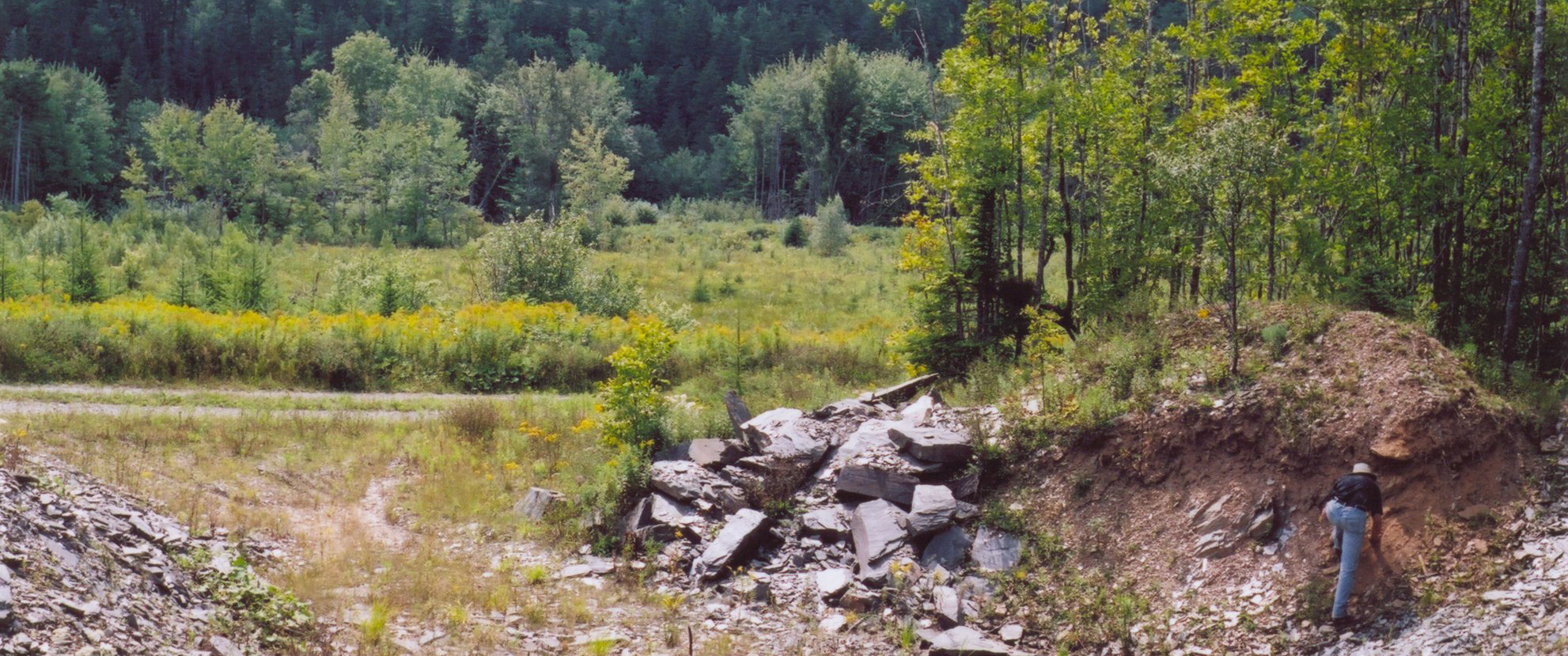
We weren’t able to find out much about the old West Gore Mine, but the promise of a black stibnite vein, “six feet wide,” sounded promising when we headed out. Upon arriving, it became obvious that the actual mining works had been abandoned many, many years ago and there wasn’t a lot to see from …

Read more …

Londonderry Pilgrimage

Londonderry (then called Acadia Mines) was the location of a large iron mine and works until the 1920s. While no longer used to produce iron, the colours reported from this site included a wide range: Raw Umber, Burnt Umber, Brown Ochre, and Indian Red. This sounded promising, and we thus made it the first stop …

Read more …

Elephantium Pigment

Historically, the making of ivory black was first described in the 4th century BC. The process and the resulting pigment were largely unchanged until the last factory to make this pigment closed in Germany in 1929. To this day, Ivory Black or its close relative, Bone Black, is still the most widely used black. The …

Read more …